How to Gain Experience In Order to Get Your First Internship
You should be aiming to get an internship every year, including your freshman year!
One of the biggest challenges students face: employers want experience, but it's hard to get experience if no one will hire you. The great news is that internships aren't the only way to build experience.
Do not wait until sophomore or junior year to start building your resume. Start gaining technical experience at the beginning of your freshman year. This can help propel you into some phenomenal internships your junior year - because you'll have built up so much experience.
The earlier you get involved, the more experience you'll accumulate over the next four years. By the time you're applying for competitive internships, you'll already have projects, leadership experience, research, and technical skills that set you apart from other candidates. Small steps taken early compound into a much stronger resume by graduation.
During your freshman year, your goal should be to start building your resume so that you're a stronger candidate for internships in the future. Here are some of the best ways to get experience to put on your resume:
1. Join Design Clubs or Design Competition
Check with your university to see what engineering organizations and competition teams are available. Some of the most common include:
- Baja SAE (Mechanical, Electrical, Computer, Industrial, Manufacturing)
- Formula SAE (Mechanical, Electrical, Computer, Software, Industrial, Manufacturing)
- Concrete Canoe / Concrete Car (Civil, Structural, Mechanical, Environmental)
- Solar Car (Mechanical, Electrical, Computer, Software, Industrial)
- Steel Bridge (Civil, Structural, Mechanical)
- Robotics Club (Mechanical, Electrical, Computer, Software, Mechatronics)
- Rocketry / Aerospace Club (Aerospace, Mechanical, Electrical, Computer)
- CubeSat / Satellite Design (Aerospace, Electrical, Computer, Mechanical, Software)
- EcoCAR (Mechanical, Electrical, Computer, Software, Chemical, Industrial)
- Human-Powered Vehicle Challenge (Mechanical, Biomedical, Industrial, Manufacturing)
These teams give you hands-on engineering experience that employers love to see. You'll apply concepts from the classroom to real projects, learn how to work on multidisciplinary teams, use industry tools, and have concrete examples to talk about during interviews. Even if you don't land an internship your freshman year, the experience you gain on a design team can make a huge difference when you're applying for sophomore and junior internships.
How do you find worthwhile clubs at your school?
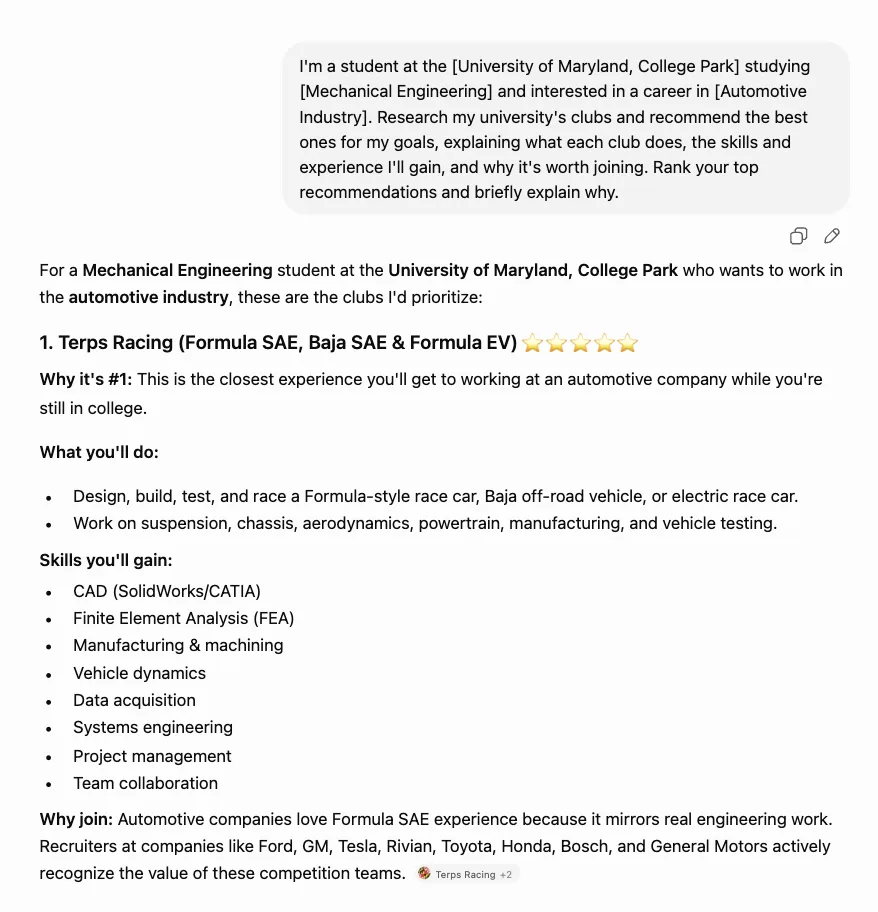
Here is a Chat GPT prompt you can use which makes this incredibly simple.
"I'm a student at [University Name] studying [Major] and interested in a career in [Industry/Field]. Research my university's clubs and recommend the best ones for my goals, explaining what each club does, the skills and experience I'll gain, and why it's worth joining. Rank your top recommendations and briefly explain why."
Example:
As you get more involved, consider running for an officer position. Leadership roles give you experience managing projects, organizing teams, and communicating with others. Just don't rush it. Spend your first year learning, contributing, and building relationships before pursuing a leadership position.
One important note about clubs: focus on joining clubs where you'll actually do something, not just show up to meetings. I'd much rather see you join one club where you're learning skills like SolidWorks, Python, CAD, or hands-on design than five clubs where all you do is attend the meetings. The experience and skills you build are what employers care about most, not that you were a member of five clubs.
2. Get Involved in Undergraduate Research
Most universities have faculty webpages that describe each professor's research interests and current projects. Spend some time finding professors whose work genuinely interests you. Then, reach out to 10 professors, some research opportunities are competitive, and it's completely normal to contact several before finding a good fit. It only takes one "yes."
Keep your email short, professional, and personalized. Show that you've taken the time to learn about their research and explain why you'd like to be involved.
When reaching out to professors, always use your university email address. It looks more professional and immediately lets them know you're a student at their institution. If your university email account includes a profile photo, consider adding a clear, professional headshot. Putting a face to your name can make your email feel more personal and reassure the professor that they're communicating with a real student.
Here is an email script you can use:
Subject: Undergraduate Research Opportunity
Hello Professor [Last Name],
My name is [Your Name], and I am a first-year [Engineering Major] student at [University].
I recently came across your research on [specific topic], and I found it really interesting, especially your work on [mention a project, publication, or area of research].
I'm looking to get involved in undergraduate research to develop my technical skills and learn more about [topic]. While I may not have extensive experience yet, I'm eager to learn, work hard, and contribute wherever I can.
I was wondering if you currently have any opportunities for undergraduate students to assist with your research. I'd be grateful for the opportunity to speak with you and learn more about your work.
Thank you for your time and consideration. I look forward to hearing from you.
Best,
[Your Name]
[Engineering Major]
[University]
3. Do a Personal Project that relates to the field you want to enter
Another great way to build experience is by completing a personal engineering project. The key is to choose a project that's relevant to the field you want to work in.
For example, if your goal is to work in the power industry, building an RC car probably won't showcase the skills employers in that field are looking for. Instead, choose a project related to power systems, electrical distribution, renewable energy, or protection and controls.
A good rule of thumb is to work backward from the jobs you want. Look at internship/entry-level postings in your target industry and identify the skills, tools, and technologies they mention. Then, build a project that demonstrates those skills. Not only will your project be more relevant to employers, but you'll also have a strong example to discuss during interviews.
Remember, the goal is to build something that helps tell the story of why you're a good fit for the role you're applying for, not just some generic electrical engineering project.
How do I figure out what projects to do?
If you're looking for project ideas that have been vetted by professional engineers in your target industry, check out the Your Engineering Sister Technical Project Vault. It's a growing library of portfolio-worthy projects designed to help you build the skills employers actually want!
Or you can leverage Chat GPT to help:
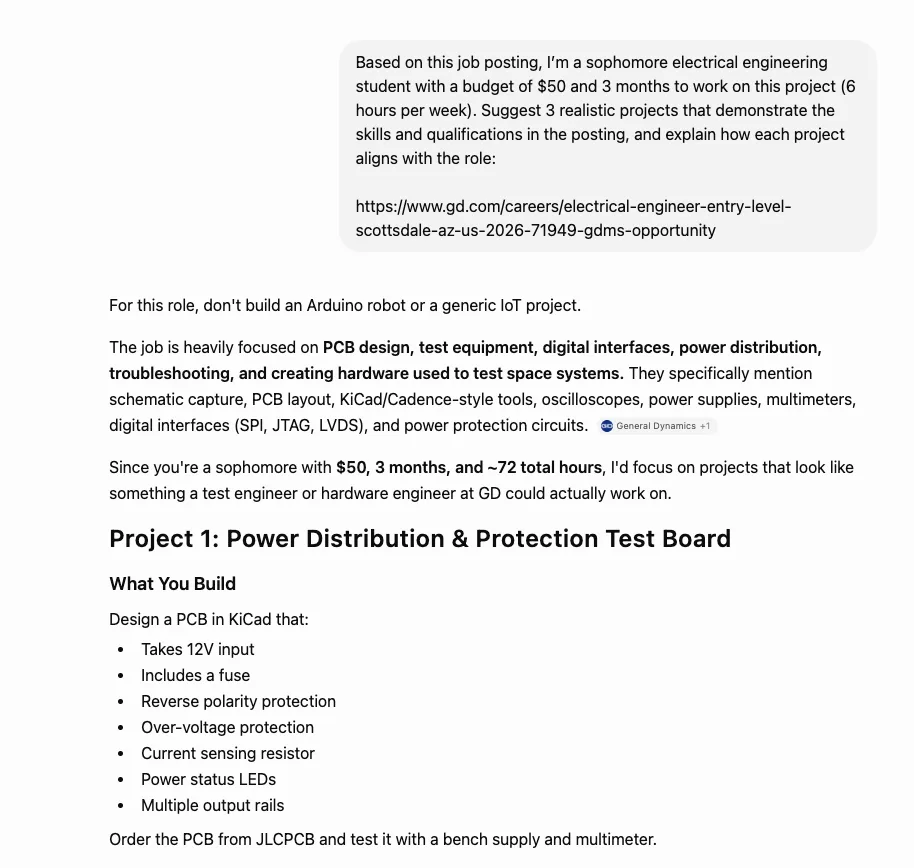
Here is a prompt you can use to ensure the project you build actually fits the bill of what employers want to see:
Based on this job posting, I'm a [insert year] [insert major] student with a budget of $50 and 3 months to work on this project (6 hours per week). Suggest 3 realistic projects that demonstrate the skills and qualifications in the posting, and explain how each project aligns with the role:
[Insert entry level or internship job posting that aligns with your interests]
Example:
4. Get Relevant Certifications
Earning certifications can be another great way to strengthen your resume, but don't choose them at random. Instead, use the companies you want to work for to guide your decision.
How to find the certifications that you should get?
Strategy #1: Search LinkedIn for something like "[Company Name] Engineering Intern" and review several profiles. Pay attention to the certifications, software, and technical skills that appear repeatedly. If you notice that many interns have the same certification: for example, a SOLIDWORKS certification, that's a strong signal that it's worth pursuing.
Strategy #2: Review internship and entry-level job postings, you are interested in. Employers often list preferred or desired certifications in the qualifications section. They are literally giving you the blueprint of what they want to see out of a candidate. If the same certification appears across multiple job postings, it's likely valued within that industry.
Note: rather than collecting as many certifications as possible, focus on earning the ones that are consistently requested by the employers and roles you're targeting. A few highly relevant certifications will usually carry more weight than a long list of unrelated ones.
Internship Search & Recruiting
Landing an internship is rarely something that happens by accident. The students who are most successful usually start preparing months before they actually submit applications.
Understand Recruiting Timelines
Many engineering companies recruit 6–12 months before the internship begins. That means if you're hoping to intern next summer, you should often begin preparing your resume, networking, and applying during the fall semester.
As a general guideline:
- August–October: Applications begin opening for many large companies.
- September–November: Career fairs, interviews, and networking events are in full swing.
- December–February: Many companies continue hiring, especially small and mid-sized employers.
- Spring Semester: Additional opportunities become available, although some of the most competitive positions may already be filled.
The earlier you start, the more opportunities you'll have.
Where to Search
Career Fairs: Career fairs are one of the best ways to land interviews. Before attending, research the companies that will be there, tailor your resume, prepare a 30-second introduction, and have a few thoughtful questions ready. Don't just collect free swag—build relationships.
Company Websites: If there's a company you're interested in, apply directly through its careers page. Many internship postings appear on company websites before they're shared elsewhere. Create a list of your target companies and check their careers pages regularly throughout recruiting season.
LinkedIn: LinkedIn is an excellent place to find internship postings, connect with recruiters, and learn about companies. Follow organizations you're interested in, turn on job alerts, and connect with alumni or current employees when appropriate.
Apply Broadly: Don't put all your hopes into one company. Apply to a wide range of internships across different companies and locations. Recruiting is competitive, and increasing the number of quality applications you submit improves your chances of receiving interviews.
Track Your Applications
Create a spreadsheet to keep track of:
- Company
- Position
- Application Date
- Status
- Interview Dates
- Follow-Up Date
- Recruiter Contact Information
- Notes
Staying organized makes it much easier to follow up with recruiters and keep track of where you are in the recruiting process.