Scheduling Classes & Finding Your "Study Floors"
One of the first things you'll do the summer before freshman year is pick your classes. Use this framework as a guide, not a rule. Everyone's schedule is different, so if you're working while you're in school, adapt it to fit the time you have available.
My recommendation is to schedule your classes as close together as possible. If you have the flexibility, try to stack them between about 9:00 a.m. and 4:00 p.m. instead of spreading them across the entire day. Having one large block of uninterrupted time in the evening makes it much easier to get into a rhythm and focus on studying, projects, or homework.
If you can, start your morning with something that wakes you up: a workout, a short walk, or any kind of movement. It doesn't have to be long, but it helps you feel more energized before heading to class. As a bonus, morning workouts are usually much more enjoyable because the gym is far less crowded than it is in the afternoon.
Of course, everyone's schedule is different, so treat this as an ideal framework rather than a strict rule. The goal is simply to create larger, uninterrupted blocks of time so you can study more efficiently.
I also like to reserve my weekend mornings for studying. By getting your studying done early, you can enjoy the rest of your day without feeling like you should be doing homework instead. Weekend mornings are also typically quieter and have fewer distractions, making it easier to stay focused.
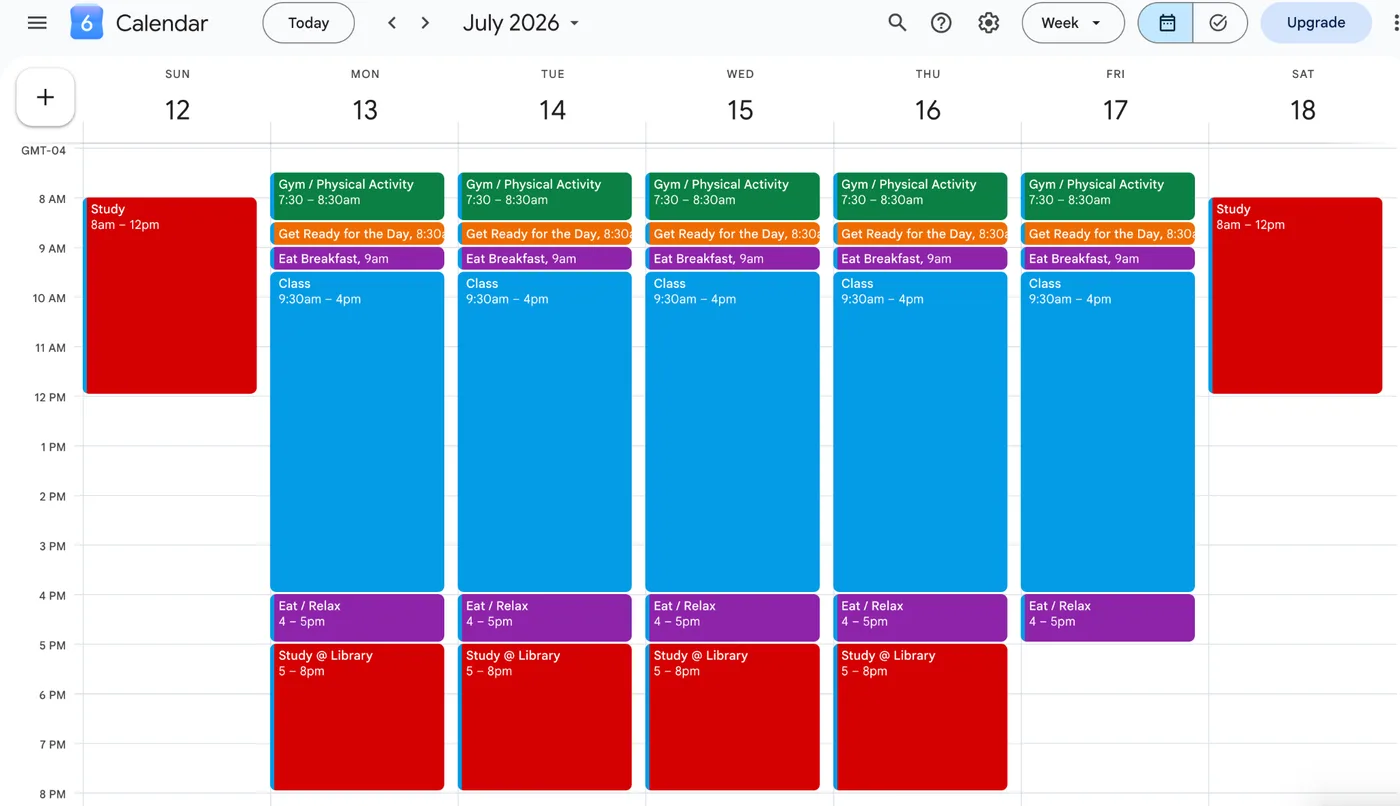
Note: This schedule includes about 20 hours of studying each week. Your goal is to determine your own study floor, the minimum number of hours you'll commit to studying and completing homework every week, regardless of what's on your calendar.
Some weeks you'll naturally study more because of exams, projects, or major assignments, but having a consistent baseline prevents you from falling behind. Even when there isn't an exam coming up, I still recommend sitting down to review your notes, work on a few practice problems, or review flashcards. Those small, consistent study sessions compound over time.
Stay ready so you don't have to get ready. If you study consistently throughout the semester, you'll spend far less time cramming, and you'll be much less likely to pull an all-nighter before an exam.
Structuring Your Days
Now that you've identified your study blocks, let's talk about how to use them effectively.
Whenever possible, try to preview the material before you attend class. You don't need to master the topic, you just want to become familiar with the basic concepts and terminology so the lecture isn't your first exposure.
For example, imagine you're taking Calculus I and your syllabus says the next topic is Limits. Before class, spend 15–30 minutes watching an introductory video on YouTube. By doing this, you'll already have a basic understanding of the concept, making it much easier to follow your professor's explanations and examples during the lecture. Instead of trying to learn everything from scratch, you'll be reinforcing what you've already seen.
One of the biggest mistakes students make is expecting the lecture to be their first introduction to a topic. Instead, think of class as an opportunity to deepen your understanding, ask questions, and connect the concepts together.
Taking Effective Notes & Focusing on the "Why"
Once you're in class, your main objective should be to pay attention & absorb the material. Do not focus on taking the perfect notes. Stay engaged, listen to your professor's explanations, and focus on "why" concepts work rather than simply writing down every word that's said. Also, take notes using pencil & paper, the research backs this up as the best way to learn.
If you're busy copying everything on the board, you're probably missing the explanation that actually makes it "click". It's okay if your notes are a little messy, as long as you leave class with a stronger understanding of the material than when you walked in.
Capture the reasoning behind each step, decision, or method. Ask yourself questions like, Why did they solve the problem this way instead of another way? or Why does this equation apply here? Those "why" explanations are often far more valuable than the equations themselves because they help you understand the underlying concepts instead of simply memorizing procedures. When you truly understand the reasoning, you'll be much better prepared to solve unfamiliar problems on homework and exams.
After Class: Where and How to Study
Once your classes are over for the day, take about an hour to eat, recharge, and give your brain a break (maybe even watch your favorite TikToker, YourEngineeringSister). Then, head straight to the library.
If you go back to your dorm first, it's much easier to get sidetracked. You might tell yourself you'll take a quick nap, play one game with your roommates, or scroll on your phone for "just a few minutes." Sometimes you genuinely need that break, and that's okay. But if your goal is to study consistently, going directly to the library removes a lot of those temptations before they even become a problem.
Your study environment matters. Personally, I love studying in individual carrel desks because they minimize visual distractions. If I can see people walking by or conversations happening around me, my attention starts to drift. Find an environment where you can stay focused for long periods of time, whether that's a quiet corner of the library, a private study room, or a desk with minimal distractions. The easier you make it to focus, the more productive your study sessions will be.
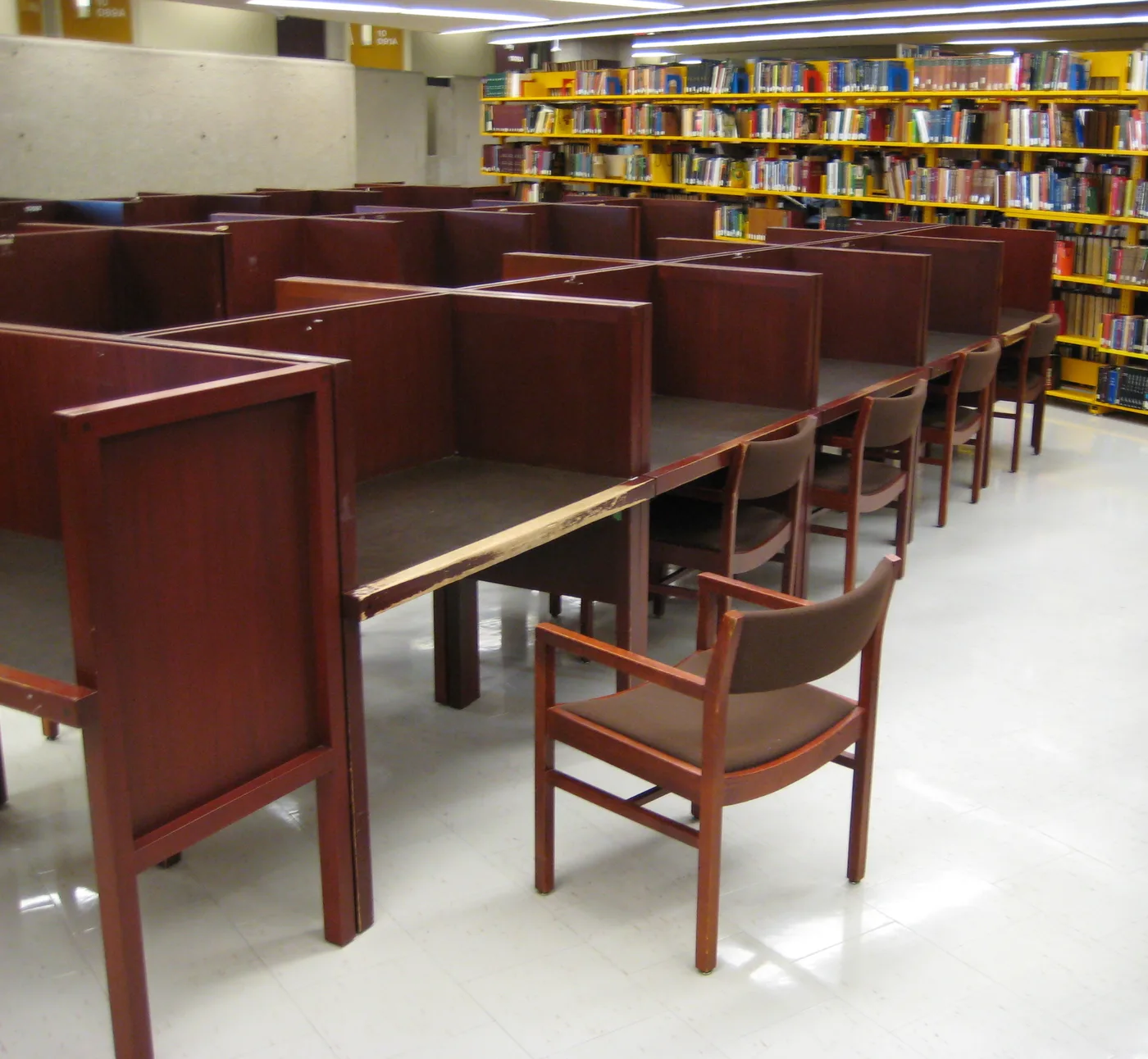
When you sit down to study, your goal should be to enter a deep work state, a term popularized by author Cal Newport. Deep work is a period of uninterrupted, focused concentration where you're able to make meaningful progress on difficult tasks. Of course, have your notifications on for emergency events. I personally liked wearing an apple watch to help alert me.
To make that possible, eliminate as many distractions as you can. Put your phone in your backpack or somewhere out of sight. Close every browser tab except the ones you actually need. Resist the urge to check notifications, emails, or social media.
I also recommend studying without music or podcasts. I used to listen to music every time I studied because I thought it helped me focus. Then I tried studying in silence, and it completely changed my ability to concentrate. Without background noise competing for my attention, I found it much easier to stay engaged with the material and work through challenging problems.
The fewer distractions competing for your attention, the easier it is to stay focused, and the more you'll accomplish in less time.
The Study Framework I Used
Once you've set up your environment, it's time to actually study. Here's the framework I used throughout engineering school.
Start by spending the first 15 minutes reviewing the notes from that day's lectures. This helps reinforce what you just learned while it's still fresh in your mind. If you come across something you don't understand, write it down and bring those questions to your professor's or TA's office hours. Don't rely on yourself to remember them later.
Next, do your homework the same day it's assigned. This was one of the biggest habits that helped me stay ahead. Starting early gives you time to get stuck, ask questions, attend office hours, and actually learn the material. If you wait until the night before it's due, there's a much higher chance you'll also be juggling another assignment, studying for an exam, or dealing with an unexpected commitment. That's when it becomes tempting to copy solutions just to get the homework submitted.
Instead, treat homework as a learning tool, not an assignment to check off your list. Use every resource available to you: your class notes, worked examples from lecture, the textbook, and any supplemental resources your professor provides. The goal isn't to finish as quickly as possible; it's to understand why each step works.
Most importantly, don't be afraid to struggle. Learning happens when you wrestle with difficult problems. Getting stuck, making mistakes, and correcting them are all part of the process. Every problem you get wrong is an opportunity to strengthen your problem-solving skills and identify gaps in your understanding.
After you've attended office hours, go back and reattempt the problems you struggled with on your own. Don't just look at the solution and move on, work through the problems until you can solve it without any help. That's when you know you've actually learned the concept.
As you review, create flashcards or a one-page summary for any formulas, concepts, or problem-solving strategies you want to remember. By building these study resources throughout the semester, you'll already have everything you need when exam season arrives. One of the biggest mistakes students make is waiting until the week before an exam to create flashcards. At that point, you should be using them to review, not spending valuable time making them.
Don't wait until exam week to review your study materials. Instead, review them periodically throughout the semester whenever you have a few spare minutes. Waiting for your next class to start? Review your flashcards. Eating lunch by yourself? Review your flashcards. Standing in line or riding the bus? Review your flashcards.
These short review sessions may only take 5–10 minutes, but they add up over time. Consistently revisiting the material helps strengthen your memory, reduces the amount of cramming you'll need before exams, and makes it much easier to retain what you've learned for future classes and technical interviews.
Keep a Wrong Problems List
I also recommend keeping a Wrong Problems List throughout the semester. Every time you miss a homework problem, quiz question, or exam problem, add it to the list along with why you got it wrong. Did you misunderstand the concept? Make a calculation error? Forget a formula? Misread the question?
When it's time to study for an exam, this becomes your starting point. Instead of reviewing everything equally, you can focus on the areas where you're actually struggling. It's one of the fastest ways to identify your weaknesses, close knowledge gaps, and improve your performance on the next exam.
If you follow this process consistently for every class, you'll stay ahead instead of constantly trying to catch up. By the time an exam approaches, you'll already know which topics you understand well and which ones still need work. Rather than wondering what to study, you'll have a clear roadmap based on your homework, office hour questions, flashcards, and Wrong Problems List.
Preparing for Exams
When it's time to prepare for an exam, my favorite strategy is to build your own full-length practice exam using old homework problems, class examples, quizzes, and any review problems your professor provides. Set aside uninterrupted time and complete it under exam conditions: no notes, no textbook, and no distractions. Once you're finished, carefully review every mistake and use those results to guide your final review.
If you have the opportunity, make friends with upperclassmen in your major. They can often provide valuable insight into a professor's teaching style, common exam topics, and effective ways to prepare. If they have old exams or practice materials they're willing to share, those can be some of the most effective study resources available because they closely reflect the types of questions you may encounter.
My Favorite YouTube Channels [Math, Physics, Chemistry, Etc.]
- Professor Leonard: Excellent for Calculus, Differential Equations, Statistics, and other college-level math courses.
- The Organic Chemistry Tutor: Great for Calculus, Chemistry, Physics, Algebra, and many other STEM subjects. His videos are concise and perfect for reviewing concepts or filling in knowledge gaps.
- Jeff Hanson: Statics, Dynamics, Mechanics of Materials (Strength of Materials).